Studies show the disparities of women representation in academic leadership are significant. Just 30% of college presidents are women, according to the American Association of University Women. For women of color, the representation is even worse: 5% of college presidents are racial or ethnic minorities.
But here in the Charlotte Region, some of the leading higher education institutions are bucking that trend, as Central Piedmont Community College, Johnson C. Smith University, and UNC Charlotte, all have women in the highest leadership positions.
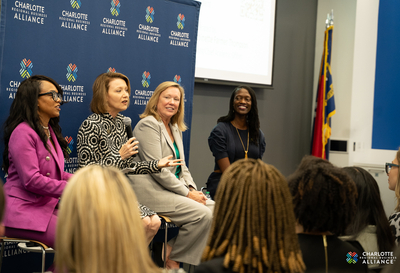
On Wednesday, those leaders came together for a first-of-its-kind panel discussion hosted by the Charlotte Regional Business Alliance. The panelists, Kandi Deitemeyer, president, Central Piedmont; Sharon Gaber, chancellor, UNC Charlotte; and Valerie Kinloch, president, Johnson C. Smith University; took part in an empowering conversation as part of the CLT Alliance’s signature event series, Power of Women.
In a room filled with close to 100 professionals and students, Deitemeyer, Gaber, and Kinloch spoke about their road to the top, the challenges along the way, and the steps they and their higher education institutions are taking to close the women’s power gap. The conversation was moderated by Antoinette Farmer-Thompson, provost and chief academic officer at Strayer University.
“As I was thinking about my next steps, and I think about the people who helped me, some of the barriers were our women friends,” Deitemeyer said. “You have a chance to change that.… The barriers that we still perceive, we control whether they change.”
Gaber spoke about a new $1 million program at UNC Charlotte that will support the next generation of women leaders. The funding came from UNC Charlotte alumna and business innovator Susan Dodson DeVore who noticed the underrepresentation of women in leadership positions and hoped to create a new legacy of empowered women.
Kinloch said the work is personal for her.
“There are so many challenges and I get all of them. And even the challenges that shouldn’t, get mapped onto me,” she said. “But these challenges I do not accept. They are opportunities to define who I am and be who I am.”