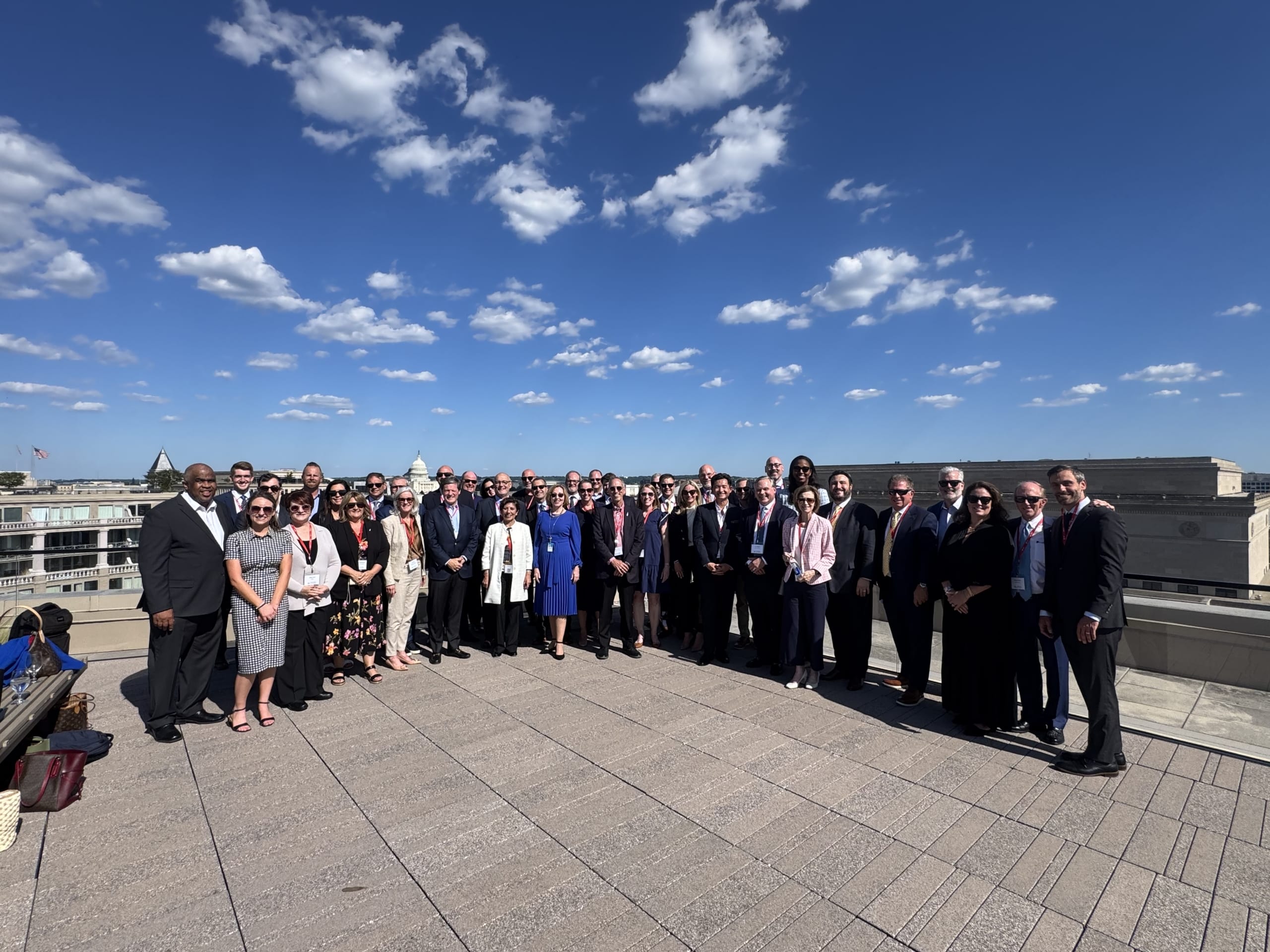
This week, Charlotte Regional Business Alliance investors traveled to the nation’s capital for the annual Washington, D.C. Fly-In. The group brought the Charlotte Region’s priorities directly to members of Congress, federal agency leaders, and national policy experts.
Over two days, participants engaged in discussions on housing affordability, transportation investment, economic competitiveness, and the evolving federal policy landscape. While the conversations centered on national issues, the implications for the Charlotte Region were impossible to miss as one of the nation’s fastest-growing metropolitan areas continues to navigate the opportunities and challenges that come with rapid growth.
Affordability Panel: Housing, Regulation, and the Cost of Doing Business
A recurring theme throughout the Fly-In was affordability and the role public policy plays in shaping the cost of living and doing business. During a panel discussion featuring Bryan Greene of the National Association of Realtors and Kevin Keane of the American Beverage Association, both speakers pointed to government regulation as a significant contributor to rising costs and argued that long-term success depends on removing barriers that impact affordability.
Greene highlighted the nation’s estimated 4.7-million-unit housing shortage and noted that many homeowners are choosing not to move, further constraining housing supply. He pointed to tax policy as one factor contributing to the issue and discussed the National Association of Realtors’ proposal to increase the capital gains exclusion on home sales from $500,000 to $1 million. For regions like Charlotte, where population growth continues to drive housing demand, increasing housing supply remains a critical economic development priority.
The discussion also underscored how regulatory costs extend beyond housing. Keane noted that regulations account for roughly 25% of the cost of building a single-family home and argued that local government policies often have a significant impact on the price of everyday goods and services. Both speakers pointed to the bipartisan 21st Century Road to Housing Act as a promising step toward addressing housing challenges, while emphasizing that successful implementation will require both agency capacity and workforce readiness.
Trade policy emerged as another affordability concern. Keane highlighted the beverage industry’s focus on steel and aluminum tariffs, particularly the “Midwest Premium,” a surcharge on aluminum that has increased substantially since tariffs were implemented. Those costs ultimately flow through supply chains and are often passed on to consumers. Greene reinforced the broader economic significance of housing, noting that it accounts for approximately 20% of national GDP and roughly 18% of North Carolina’s GDP. For Charlotte, where workforce attraction and retention are closely tied to housing availability and affordability, the issue remains central to the region’s long-term competitiveness.
Washington Update: Legislative Landscape Heading into the 2026 Midterms
The affordability conversation carried into broader discussions about Washington’s political environment. Lobbyists Rick Dearborn and Langston Emerson with Mindset DC described a federal landscape increasingly shaped by the 2026 midterm elections, with much of Congress focused on campaign positioning. While work continues on appropriations, defense spending, and the federal budget process, progress on many issues has been slow, including permitting reform despite bipartisan support.
Even in this environment, several policy areas continue to draw attention. Housing legislation remains one of the few issues viewed as having a realistic path forward before the midterms, reflecting the growing national focus on affordability.
Discussions also touched on cryptocurrency market structure, predictive markets, artificial intelligence, and the Farm Bill. Health care and AI were identified as areas likely to remain at the forefront regardless of election outcomes, particularly as policymakers grapple with questions surrounding workforce impacts, infrastructure needs, and public trust in emerging technologies. These discussions are especially relevant for Charlotte, whose economy is anchored by leading financial services, health care, and technology employers that will be directly affected by future federal policy decisions.
Transportation Momentum and Opportunity
Transportation investment, another key priority for the Charlotte Region, was also front and center during the Fly-In. Speakers provided updates on the federal surface transportation reauthorization process and discussed opportunities for communities seeking federal infrastructure support.
The transportation panel featured Amanda Mays (U.S. Chamber of Commerce); Connor Torossian, (Federal Transit Administration); Marc Molinaro (Federal Transit Administration); Pete Gould, (Boundary Stone Partners); and Leif Dormsjo (Redgate).
Pete Gould of Boundary Stone Partners noted that the previous surface transportation authorization expired at the end of May and highlighted a new proposal that includes $87.6 billion for transit. Representatives from the Federal Transit Administration emphasized that future Capital Investment Grant awards will likely favor projects supported by dedicated local revenue sources. They also noted that Charlotte is well-positioned to compete for future federal funding opportunities.
The conversation reinforced the importance of continued planning and investment as the region advances its transportation goals. Federal officials highlighted the agency’s technology-neutral approach to transit projects, including bus rapid transit, while transportation finance experts discussed innovative funding tools such as Transportation Infrastructure Finance and Innovation Act (TIFIA) loans. For a growing region like Charlotte, where infrastructure demands continue to increase alongside population growth, access to federal funding and financing options will remain critical to delivering mobility improvements and supporting economic expansion.
Conversations with Members of Congress
On day two of the Fly-In, the group heard from several members of Congress from North Carolina. The congressmembers discussed their priorities, including addressing workforce shortages in health care and other industries, the importance of America leading on AI policy, a balanced approach to data centers, and the importance of the American Airlines hub at Charlotte Douglas International Airport. The delegation is focused on business community priorities, including workforce partnerships, housing and affordability solutions.
All members spoke about the continued need to work toward bipartisan solutions and to work with the business community to understand the economic needs facing the state and the country.
Takeaways
The Fly-In reinforced the importance of maintaining a strong federal presence as the Charlotte Region continues to grow. Whether discussing housing affordability, transportation investment, workforce needs, or emerging technologies, a consistent message emerged: decisions made in Washington have direct consequences for the region’s economic future. By engaging with policymakers and federal leaders, CLT Alliance investors helped ensure Charlotte’s voice remains part of the national conversation and that the region is well-positioned to compete, grow, and thrive in the years ahead.