
Charlotte Douglas International Airport (CLT) is the Charlotte Region’s biggest economic asset, connecting people and businesses to global markets and adding billions of dollars to state and local economies. The largest airport in the Carolinas by far, CLT generates nearly $40 billion in annual economic impact. The airport also supports 167,000 jobs in a variety of fields, including airport services, airline operations, airplane maintenance, transportation, and hospitality.
That level of connectivity reflects a region that has been growing rapidly for centuries. By 1930, Charlotte had solidified its position as the state’s largest city — a title it still holds today. In the decades that followed, the city’s continued growth has been propelled by a rapidly expanding banking sector, establishing Charlotte as the second-largest banking hub in the country. The strength of CLT has played a major role in attracting businesses and investments to the Charlotte Region.
Today, CLT serves an ever-increasing population. In 2024, a record 58.8 million passengers traveled through CLT, establishing it as the seventh busiest airport in North America for passenger traffic. The airport also ranked sixth in the world for aircraft landings and takeoffs in 2024.
A large part of CLT’s advantage lies in its geography. No other hub airports are located within a 200-mile radius of CLT, reinforcing its strategic importance – not only for the Charlotte Region, but for the Carolinas as a whole.
American Airlines: A global gateway at CLT
At the center of the airport’s success is the American Airlines hub and the airline’s continued investment in Charlotte. Originally established as a primary hub for Piedmont Airlines in 1982, the operation evolved through a series of high-profile mergers with USAir and US Airways before becoming the second-largest American Airlines hub it is today.
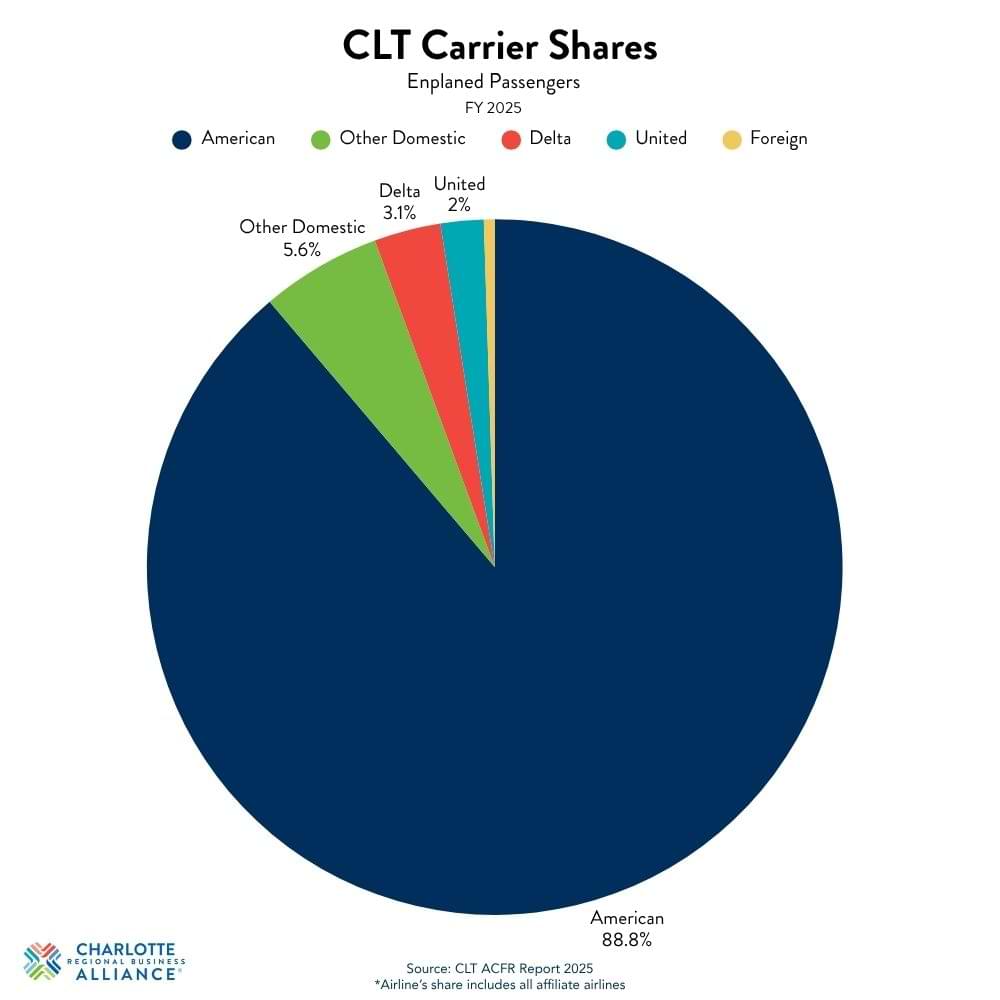
As the airport’s dominant carrier, American Airlines and its subsidiaries accounted for nearly 90% of the total passengers who traveled through CLT during the 2025 fiscal year.
American Airlines invests more than $30 billion into North Carolina’s economy annually. Its operation at CLT also supports 150,000 jobs across the state, generating $1.7 billion in local and state tax revenue each year.
Together, these factors underscore the critical role the American Airlines hub plays in driving connectivity, supporting good-paying jobs, and advancing the region’s long-term growth.
American’s growth has transformed Charlotte into a global gateway, with the airline now offering nonstop service to more than 170 destinations, including 41 international destinations. In the last few years, the airline has added direct flights to new international destinations like Madrid, Spain; Calgary, Quebec City; and Vancouver, Canada; while also serving London-Heathrow three times a day year-round.
American’s transatlantic flights support significant foreign direct investment in the Charlotte Region. In the past 10 years, foreign firms have invested $6.5 billion in capital investment and created more than 20,000 jobs in the region. These firms are supported by American’s transatlantic service; in addition to its London and Madrid flights, the airline offers seasonal flights to Rome, Italy; Dublin, Ireland; Paris, France; and Athens, Greece.
American has also added several direct routes to domestic markets, including top leisure destinations like Jackson Hole, Wyoming; Bozeman, Montana; and Vero Beach, Florida, as well as multiple flights to the Caribbean.
The CLT Advantage
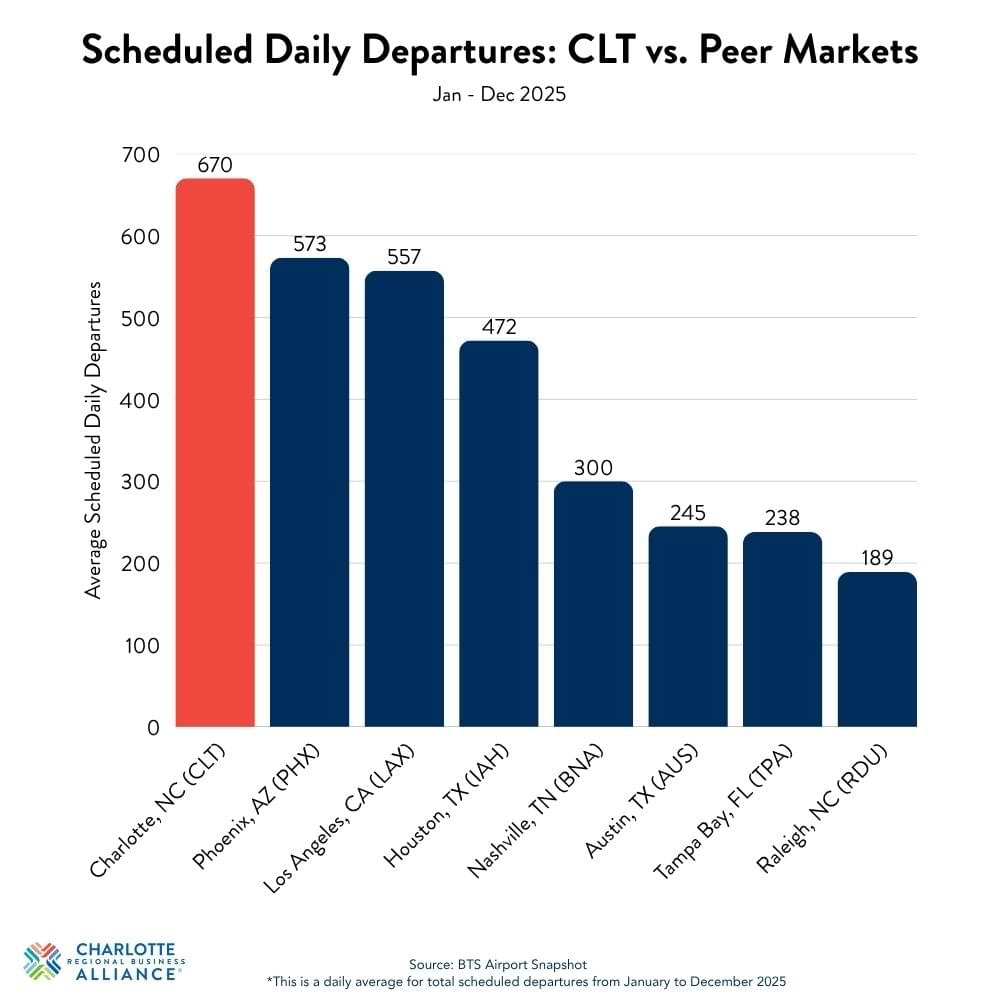
The scale of CLT’s connectivity is massive in comparison to many of Charlotte’s peer cities. Major airport hubs like Phoenix (PHX), Los Angeles (LAX), and Houston (IAH) record fewer daily departures than Charlotte does, despite serving populations double or triple its size.
CLT’s reach becomes even more apparent when compared to non-hub airports in Charlotte’s peer cities like Austin, Nashville, and Tampa. CLT saw nearly 570,000 combined takeoffs and landings in 2025, with an average of 670 scheduled departures per day. While non-hub airports in similarly sized metros are also regional assets, they do not see nearly the same level of connectivity that CLT does.
The Charlotte Region’s accessibility gives it a significant advantage in business attraction and retention. New-to-market companies can leverage a lower-cost business environment while having the same level of connectivity to global markets. The region’s existing employers easily move their people and products around the world, increasing productivity and efficiency. That connectivity starts locally. From many of Charlotte’s major office submarkets, including Uptown, South End, Ballantyne, and SouthPark, the average drive to the airport is just 20 minutes.
American Airlines offers an average of 60 daily flights to major financial markets in the U.S. and Europe, a key advantage for Charlotte’s financial services firms. Those markets include New York City, San Francisco, Chicago, and Dallas, as well as London, England, and Frankfurt, Germany. American’s subsidiaries provide key connectivity for smaller markets across the Southeast and the Midwest. CLT is also a critical part of the region’s logistics infrastructure, offering manufacturers rapid cargo transport capabilities, an on-site intermodal facility, and proximity to major interstates. In 2024, American moved 21,000 tons of cargo through CLT.
Future Growth
CLT has seen prolific growth over the last 20 years, largely due to its status as a hub for American Airlines. The airport is currently undergoing a $4 billion capital investment plan called Destination CLT, a collaborative effort between the airport, the airlines, and government partners, for critical capacity enhancement projects. Upgrades include the recently updated Terminal Lobby Expansion, two new concourses, and a fourth parallel runway, which will add even more daily flight capabilities.
An average of 157 people move to the Charlotte Region every day, placing steady demand on the infrastructure that keeps the region connected and competitive. Continued investment in the airport will be essential to ensuring the region can keep pace.
CLT and the Charlotte Region share a powerful, mutually reinforcing story. Anchored by American Airlines’ second-largest hub, the region’s global connectivity continues to strengthen its competitive position on a national and international stage. As the region continues to expand, that connection will remain vital to driving business investment, attracting talent, and supporting its future.