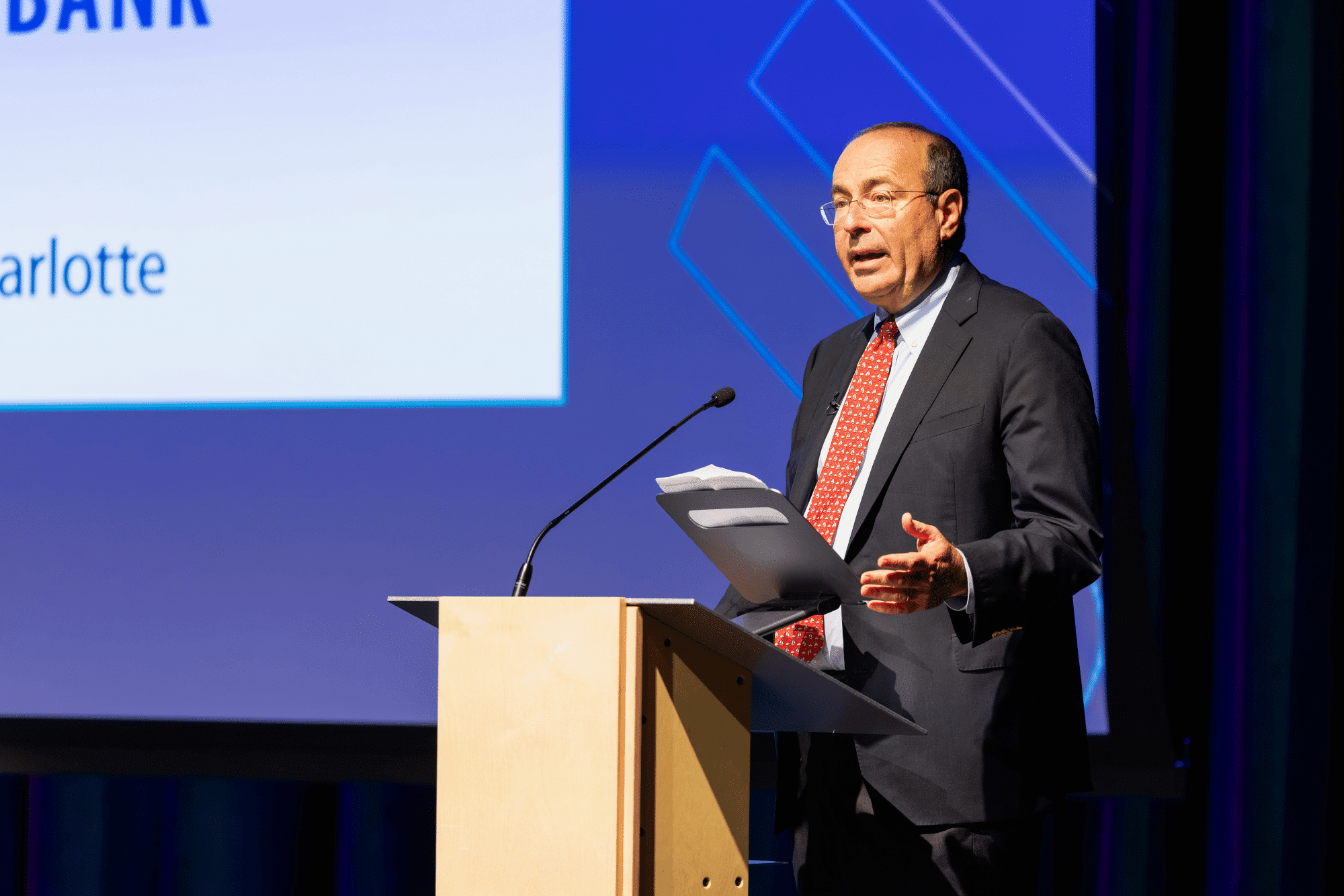
Charlotte Regional Business Alliance investors gathered Tuesday at Central Piedmont Community College for the organization’s Investor Quarterly Meeting, featuring a candid conversation with Tom Barkin, president and CEO of the Federal Reserve Bank of Richmond.
Central Piedmont President Dr. Kandi Deitemeyer, who moderated the conversation, opened the event by highlighting the college’s momentum: this semester marks one of the largest enrollments in CPCC’s history, and scholarship giving has grown from $1 million to nearly $5 million during her tenure.
Defying Expectations
Barkin began by acknowledging a familiar tension. Inflation remains above target and real income has slipped, yet several recession signals still haven’t materialized.
“The indicators that typically predict recessions have been sounding the alarm on and off for years,” he said.
But it hasn’t happened. The economy has remained resilient and spending hasn’t slowed. Using a boxing analogy, he said the economy was in the 10th round. Having taken several punches, it is still standing.
Barkin believes consumers who lived through the pandemic learned that the unimaginable can happen. He thinks many shifted toward enjoying the moment rather than saving aggressively, which is what many did after the Great Recession. Barkin said in the case of lower-income consumers, they are making tradeoffs to keep spending.
“People want to spend money and they don’t want to stop,” he added later.
Business investment tells a similar story. Even as supply chains, energy, and materials cost more, companies keep investing at levels Barkin compared to the historic railroad buildout in the 19th century. Artificial intelligence is driving much of it, from data centers to mergers and acquisitions to new factories, and demand hasn’t let up. Second-quarter earnings rose more than 30%, and forecasts keep getting revised upward. A modest uptick in productivity, tied in part to post-pandemic gains in the labor supply, has helped as well.
‘Low hire, low fire’ labor market
Unemployment remains low even as headlines feel gloomy, and Barkin walked through why. Hiring has slowed to roughly 2013 levels as firms stay cautious amid uncertainty, but those same firms aren’t laying workers off either, a sign that underlying demand remains healthy.
Fewer jobs are being added, he said, but fewer people are looking for them too. Declining numbers of high school and college graduates, rising baby boomer retirements, and a historic decline in immigration all point toward a tighter future workforce, not job scarcity.
Looking further out, Barkin pushed back on fears of a coming labor shortage driven by AI. Most current AI use cases, he noted, don’t show a clear path to headcount reduction. AI may actually open the door for a wider range of people to join the workforce with different skill sets. His bigger concerns lie elsewhere: skill mismatches in the trades, and whether healthcare will have enough staff to support an aging population.
Addressing inflation
Barkin talked about the Fed’s 2% inflation target, saying that in March 2025, the economy sat close to target before a mix of factors, including the Iran war and tariff policy, pushed inflation up into the mid-3% range. Resolving those pressures would help the inflation rate, he said, though how much remains an open question. He noted that unemployment has held at or below 4.5% for 58 consecutive months and that GDP growth has sat in the 2% range, evidence, in his view, that the economy is in a good spot.
So why doesn’t it feel that way? Barkin pointed to a steady diet of negative news reaching consumers and businesses, even as many of the business leaders he talks with are surprised by the strength of demand they’re seeing. What business leaders want most, he said, is stability, and they don’t feel that after reading news headlines.
What makes Charlotte special
Asked what has stood out most about the Charlotte Region, Barkin pointed to its sheer scale. He admitted he hadn’t fully grasped the breadth of the region before, from the scope of major infrastructure projects to the pace of growth. Housing access, he noted, remains a pain point many fast-growing regions share, but he noted the Charlotte Region is building quickly.
Barkin also shared some of the most unusual indicators he’s relied on in his role. In May 2020, he visited Bristol, Virginia, just after the Tennessee side of the city reopened its economy. In Tennessee, he found a mall packed with shoppers, an early signal of the pent-up spending that would follow broader reopening. He pointed to more recent conversations with poultry processors on Maryland’s Eastern Shore after temporary protected status was revoked for Haitian workers; when those employers found replacements without major disruption, it offered a real-time read on labor market slack.
Tom Barkin’s visit was hosted by the Charlotte Regional Business Alliance on Aug. 25, 2026 as part of its ongoing Investor Quarterly Meeting series, connecting CLT Alliance investors with leaders shaping the region’s economic future. Thank you to Central Piedmont Community College for hosting at its Parr Center.