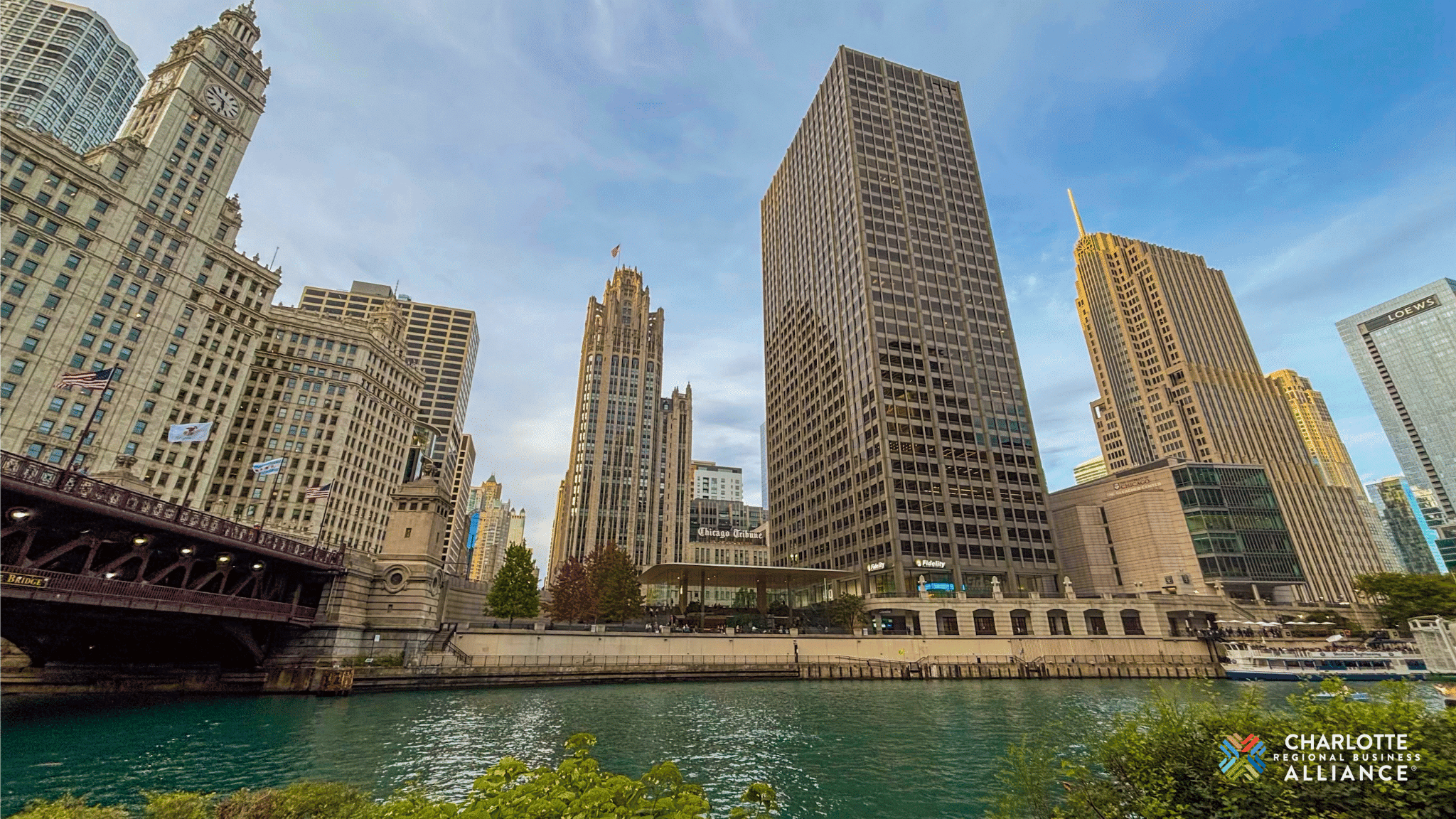
In late September, more than 140 business and civic leaders from the Charlotte Region traveled to Chicago to study what it can teach a region still deciding what it will become.
The Charlotte Regional Business Alliance’s Exploring Economies trip covered office redevelopment, public-private partnerships, transportation, and sports districts. Across every session, one idea kept surfacing: in Chicago, almost nothing consequential gets built by one sector acting alone.
‘Great cities can learn from each other’
CLT Alliance President and CEO Robert McCutcheon opened the trip by describing Charlotte at “an incredibly important moment.” The region is attracting companies and people, building infrastructure and rethinking its center city, transportation, and sports and entertainment.
“We didn’t come to Chicago because we want Charlotte to become Chicago,” McCutcheon said. “We came here because great cities can learn from each other.”
He asked attendees to listen for one theme all week: partnership. Charlotte often debates what government, business, or philanthropy should each do, he said, when the more powerful question is “what can we accomplish together that none of us could accomplish alone?”
CLT Alliance Board Chair Dave Katz, a Chicago native, then led a fireside chat with Kraft Heinz CEO Steve Cahillane, a former colleague from their years at Coca-Cola Enterprises. Asked what makes a great headquarters city, Cahillane named a strong international airport, quality schools, a reliable record on safety, civic-minded business leadership, culture and sports, and universities. When Katz asked where he would invest first if Charlotte were his business, Cahillane recommended a gap analysis to ask the questions, “What’s missing? What do you want to accelerate?”
He added that Charlotte is clearly doing a lot right.
“There’s so much energy in Charlotte. There’s so much happening.”
Moving people and goods
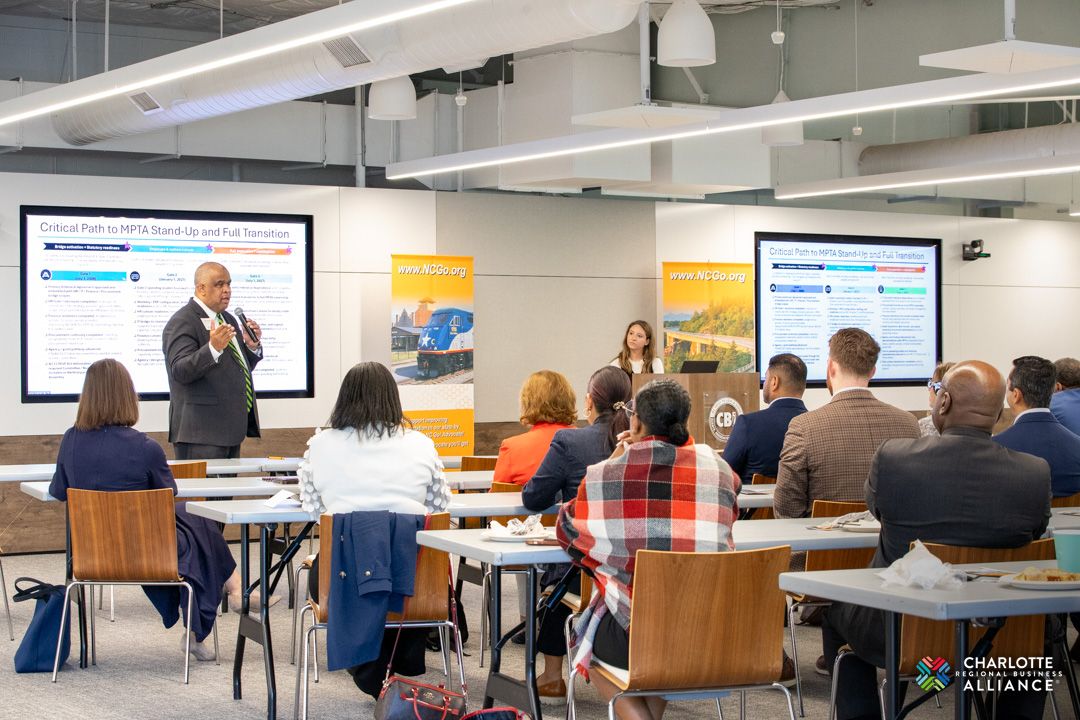
At the Old Post Office, the largest historic redevelopment in U.S. history, Mecklenburg County Manager Mike Bryant framed transportation as a defining test for the region. “The decisions we make in the next two to five years will define our region for decades to come,” he said. He pointed to last year’s voter-approved 1% sales tax for transit and restated his goal of making Charlotte-Mecklenburg an international destination.
TTX CEO Marty Thomas explained why the rail car cooperative moved its headquarters from Chicago to Charlotte. Airport access was “huge,” he said, along with affordability, talent, and an easy commute. Thomas also predicted freight rail is headed for its best year in decades.
Val Marchevsky, who leads logistics technology and the Chicago Innovation Center at Uber Freight, described how the company optimizes freight across thousands of shippers, shifting suitable loads to rail and combining shipments to cut empty miles. Uber Freight recently doubled its Charlotte presence.
“Charlotte has pretty much everything that it takes,” Marchevsky said.
Dave Lundy, CEO and founder of O’Hare Flyer, previewed a plan to connect downtown Chicago to O’Hare in 15 minutes, with trains every 15 minutes, by repurposing underused freight lines. Similar airport express trains run in about two dozen cities worldwide.
“We just don’t build these in America,” Lundy said. “And it’s time we start.”
American Airlines Chief Commercial Officer Nat Pieper said the airline will add Charlotte–Barcelona service next year and wants to grow further. Additionally, American is close to announcing a large wide-body aircraft order.
“I want to put some of them in Charlotte, but we’ve got to have a facility, and we’ve got to have long-term commitment on both sides.”
Partnerships built to last
At the Old Post Office, Truist’s Jenna Kelly opened a panel on public-private partnerships. “Great cities don’t just happen; it takes partnership,” she said. City of Charlotte Economic Development Director Sha Rana moderated.
Navy Pier President and CEO Marilynn Gardner described the pier’s 2011 shift from a government agency to an independent nonprofit, a structure that let her team “work very quickly.” Its record of keeping promises kept funders coming back.
“Everything we said we were going to do, we delivered,” she said.
Christine Zrinsky, the recently retired executive director of the Millennium Park Foundation, recounted how about 125 donors each gave at least $1 million to build the park. Despite cost overruns and pushback from neighborhoods, the park turned downtown into a place people want to live. The Loop is now the city’s fastest-growing neighborhood.
Kyle Schulz of the Chicago Metropolitan Agency for Planning and Lisa Dziekan of Clayco described the Illinois Quantum and Microelectronics Park, which is transforming a former U.S. Steel site vacant for about 30 years. Schulz said after two decades of failed attempts, the project would not have happened without the regional economic partnership Chicago-area governments formed in 2020. He pointed to the Charlotte Regional Business Alliance as a comparable model.
Dziekan emphasized that a plan needs money behind it.
“Until you have capital, until you have your private sector partners, you just have a pretty picture,” she said.
Asked by Charlotte City Councilmember Ed Driggs why companies commit to civic projects, the panel described an expectation built into Chicago’s business culture since the Great Chicago Fire. “If you are going to be in Chicago,” Schultz said, “your minimal expectation is that you are part of this civic fabric.”
Three routes for aging office towers
Charlotte Center City Partners President and CEO Michael Smith began a panel on redevelopment with a challenge both cities share. In Charlotte’s center city, office buildings completed after 2000 are 91% occupied, and nearly all vacancy sits in older towers. Charlotte currently tracks about two dozen of those buildings for modernization or conversion, with eight conversions underway that will add 1,600 apartments and 760 hotel rooms.
Chicago developers described three ways to bring a distressed building back:
- Subsidized. Riverside Investment & Development is converting the Art Deco Field Building on LaSalle Street into 400 apartments, 30% of them affordable at 60% of area median income. The deal combines federal historic tax credits, a county property tax freeze, and $100 million in tax increment financing. “If affordable housing is your priority, the free market isn’t going to be able to subsidize the rent reduction,” said Riverside President Tony Scacco. “So you’re going to need a public-private partnership.”
- Unsubsidized. WindWave Real Estate founder Jonathon Cordell screened 165 buildings before converting the former Salesforce headquarters into 153 apartments, with no city subsidy. The project went from construction start to first move-ins in about 10 months and was more than 80% leased a few months later. Speed made the math work. Chicago helped by easing bedroom rules and creating a mechanical ventilation pilot for buildings without operable windows.
- Hotel-led. Prime Group Holdings Chairman and CEO Michael Reschke made the case for hospitality. His 232-key LaSalle Chicago hotel generated almost $7 million in taxes last year and supports 180 permanent jobs. When it opened in 2010, it was the first luxury hotel built in the Loop since the 1920s. Almost 30 hotels have followed. “It only takes one big project to transform the city,” Reschke said.
Heitman Senior Advisor Mary Ludgin explained how an Urban Land Institute technical assistance panel gave Chicago’s leaders the independent analysis they needed to reopen a frozen tax increment financing district on LaSalle Street. The recommendations survived a change in mayors and now support six projects.
Districts that work on a Tuesday night
Bank of America’s Grace Nystrum opened the final panel by setting the stakes.
“The question is no longer whether we invest in sports and entertainment infrastructure,” she said. “The question is how do we maximize the return on that investment?”
Moderator Jake Burns of Tepper Sports & Entertainment noted that Bank of America Stadium, which once hosted about 10 football games a year, now hosts almost 50 major ticketed events annually, with about $1.1 billion in economic impact.
Chicago’s panelists shared three models for building activity around a venue:
- The 78. Related Midwest’s Charlie Trotier described a 60-acre riverfront site that sat undeveloped for more than 100 years until the Chicago Fire’s privately funded stadium gave it an anchor. Nate Engel, who leads business operations for the Fire, said the stadium is designed to host far more than its roughly 25 home matches.
- The 1901 Project. Marianne Rotole of the United Center outlined a $7 billion, privately funded plan to turn 55 acres of surface parking into a West Side neighborhood with a music hall, hotel and more than 20 acres of green space. It followed a 10-year community listening process. “They’ve been brought along, not just informed,” Rotole said.
- Wrigleyville. Marquee Development’s Eric Nordness showed how Gallagher Way fits a hotel, retail, office, and a conference center onto 4.5 acres next to Wrigley Field. In this model, Wrigley came before development did. “You can provide a lot of fan experience, a lot of commerce, a lot of community in a small space,” he said.
Every panelist returned to the same challenge: giving people reasons to visit on the hundreds of days without an event. Chicago Architecture Center President and CEO Eleanor Gorski described the goal as a neighborhood where visitors realize a game is happening only after they arrive.
What Charlotte brings home
The sessions covered different industries, but their lessons pointed in the same direction. Chicago’s most successful projects shared a bold vision, committed capital, patient community engagement, and plans that outlasted any single administration. Each depended on government, business, philanthropy and neighborhoods working toward a shared goal.
For the Charlotte Region, the timing matters. At roughly a third of Chicago’s size, the region can still shape its transit system, its center city, its airport, and its sports districts before growth locks choices in. Cahillane’s advice offers a practical starting point: identify what’s missing, decide what to accelerate, and stay willing to revisit big decisions as conditions change.
“We have such great clay to work with in this community,” McCutcheon said.
The work ahead is in shaping it, together.