
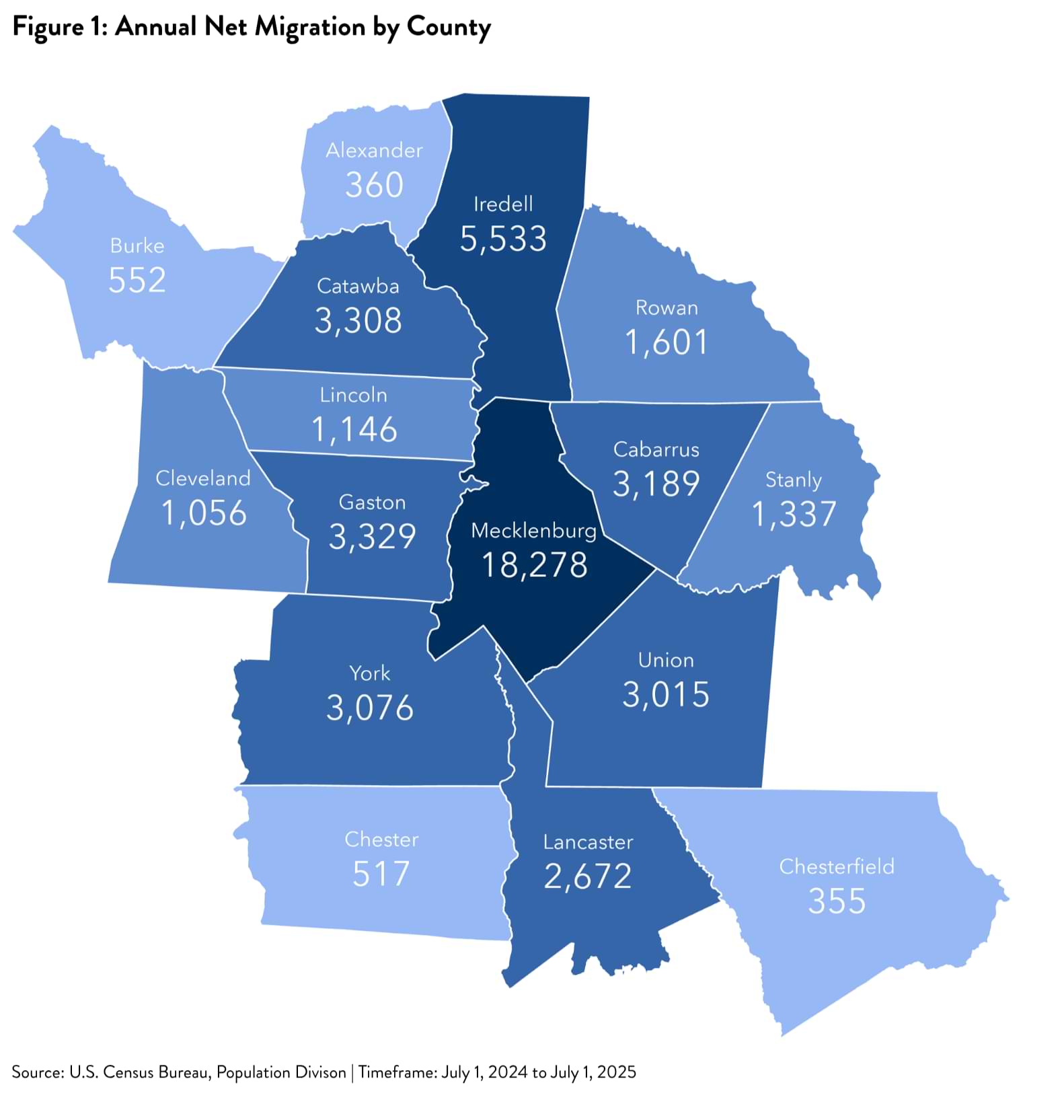
Between July 1, 2024, and July 1, 2025, the Charlotte Region1 saw a net gain of 49,324 residents through migration alone, not including births. Averaged daily, this translates to 135 people choosing to call the 16-county region home every day.
This is slightly lower than last year’s average, attributed directly to a nationwide dip in international migration. Still, every county across the Charlotte Region saw positive net migration, with Mecklenburg and its neighboring counties leading the way.
“What stands out in this year’s numbers is how broadly the growth is shared across the Charlotte Region,” said Tracy Dodson, COO and head of economic development for the Charlotte Regional Business Alliance. “Every county in our region added new residents, which tells us the growth is a region-wide vote of confidence. Our ability to keep attracting new residents shows the staying power of what makes this region work, for businesses and the people who choose to build their lives here.”
How Charlotte’s growth stacks up
To compare the Charlotte area’s growth to peer markets, the Charlotte metropolitan statistical area (MSA) is the most appropriate boundary to use. The 11-county MSA added 117 net movers per day. Some of Charlotte’s biggest peer markets trailed behind, with Austin adding 102 newcomers per day and Atlanta adding 100. Nashville and Tampa trailed even further, with the latter adding less than half of Charlotte’s daily total. And the Dallas-Plano-Irving metro division saw just 150 movers per day, despite having a population two times the size of Charlotte’s. Among these peer markets, the year-over-year decline of net movers ranged from 7% to 69%.
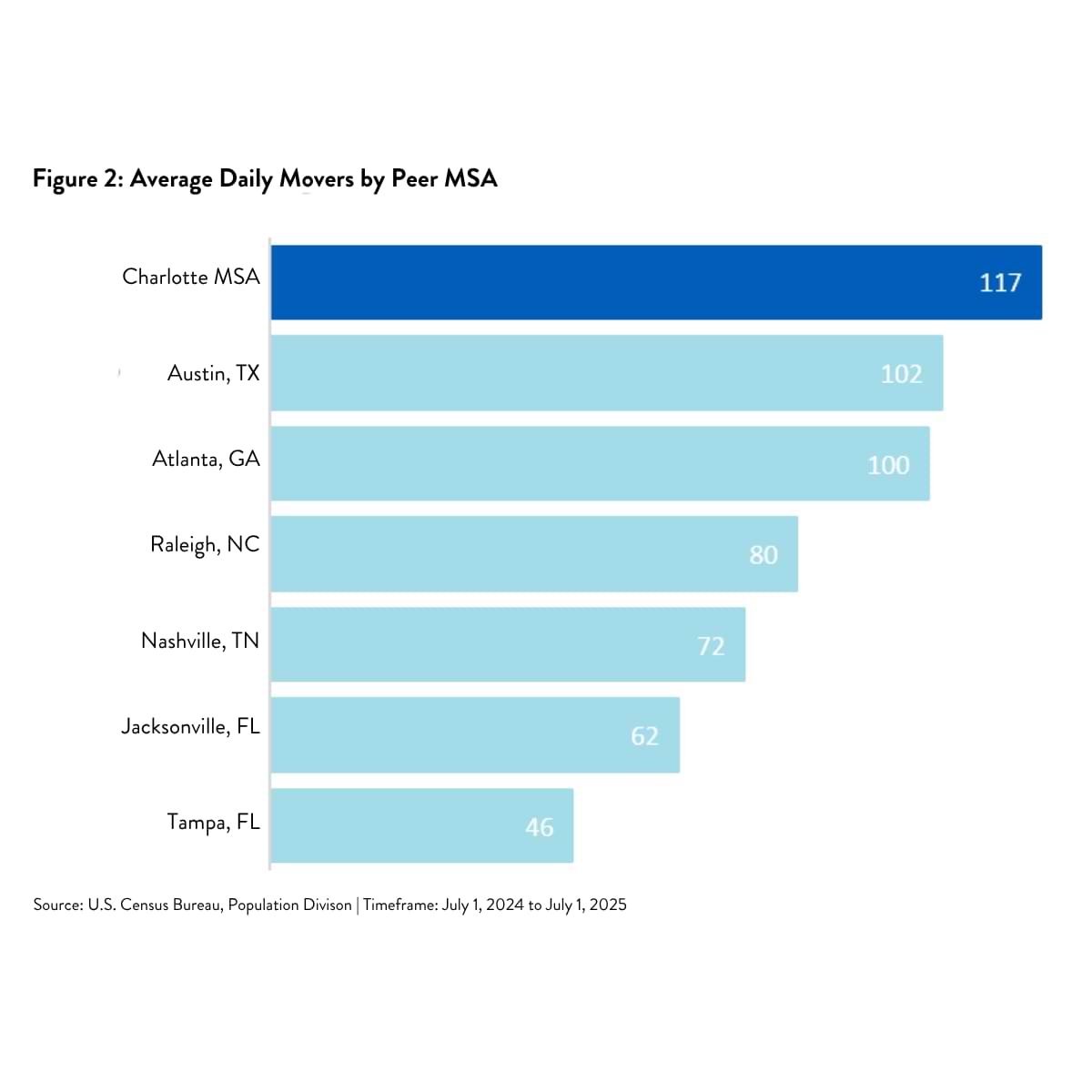
Charlotte’s quality of life and its low-cost business climate have made the region a destination for companies and talent alike. Both help explain why Charlotte continues to lead the majority of its peers. In fact, the Charlotte Region’s 16-county net migration is higher than that of 42 states, including California (-119,799), New York (-41,952), Ohio (40,431), and Virginia (46,704).
“The Charlotte Region has emerged as a destination of choice, attracting talented people with abundant career opportunities, thriving communities, and an exceptional quality of life,” said Roger Johnson, director of the Mecklenburg County Office of Economic Development. “This continued influx of talent strengthens the economy, accelerates innovation, and debatably makes us the nation’s leading region for long-term growth.”
Population data, which includes births, deaths, and migration, also reflects a strong growth story across communities in the Charlotte Region. This year, the city of Charlotte had the largest population gain of any city in the nation. Fort Mill was also ranked among the nation’s top 20 fastest-growing cities.
Charlotte: First in domestic migration
Charlotte led the entire country in domestic migration, adding 30,358 people from within the United States from 2024 to 2025 — a slight increase from the previous year’s 28,298. This places the Charlotte MSA first in domestic migration, surpassing Dallas, and fourth in total net migration, moving past New York City, Miami, Orlando, Washington D.C., Seattle, and Tampa Bay. Even as international migration trends shift nationally, this sustained growth remains a powerful asset for the region.
While the U.S. Census Bureau’s migration estimates from this timeframe do not identify details about where these movers came from, the American Community Survey’s migration flow data from 2023 shows people are mostly moving from New York City, Miami, Philadelphia, Washington D.C., and Los Angeles.
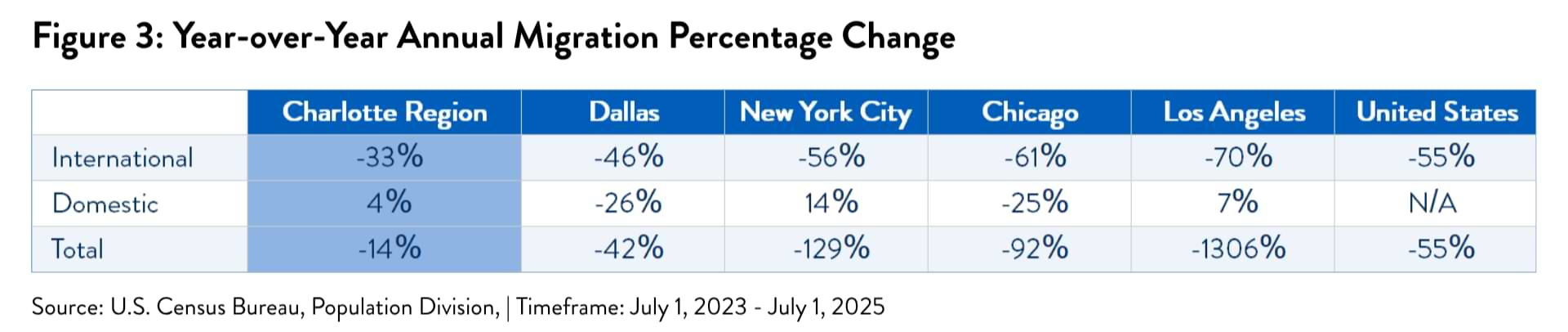
This year, U.S. international migration was down 55% from 2.8 million people to 1.3 million. Regionally, this resulted in a decrease of nearly 10,000 international migrants to 18,966–a 33% decrease from the prior year. In comparison, international migration to Dallas decreased by 46%, NYC decreased by 56%, Chicago decreased by 61%, and Los Angeles decreased by 70%.
Is Charlotte adding enough jobs?
Charlotte’s growing job market signals a bright future, and the workforce is poised to grow right alongside it. New jobs are opening across key industries and employers need workers who are ready to fill them.
The Charlotte Region added 17,000 net new jobs between July 2024 and July 2025. The health care, financial services, construction, and hospitality sectors saw the most job growth in that time period. Manufacturing also flourished in the region’s rural counties. Stanly County stood out with a striking 14.4% surge in manufacturing employment. Alexander and Chester counties contributed steady gains of 2.1% and 1.9%, respectively, evidence that industrial growth is still strong in the Charlotte Region.
“Adding 17,000 net new jobs in a single year is a powerful signal that businesses continue to invest here,” said Thaddeus Jones, founder of Charlotte-based Nexus Search Partners. “Charlotte is one of America’s premier destinations for leadership talent, innovation, and long-term business success. We believe Charlotte’s greatest competitive advantage has always been its people. We’re proud to play a small role in helping shape the next generation of leadership that will continue moving our region forward.”
Meanwhile, companies continue to invest in the Charlotte Region. Companies like Scout Motors, SMBC, and Eli Lilly have chosen the Charlotte Region for significant hubs, contributing to nearly 15,000 new jobs announced since 2024. These investments signal a region ready for continued growth.
A region built to scale
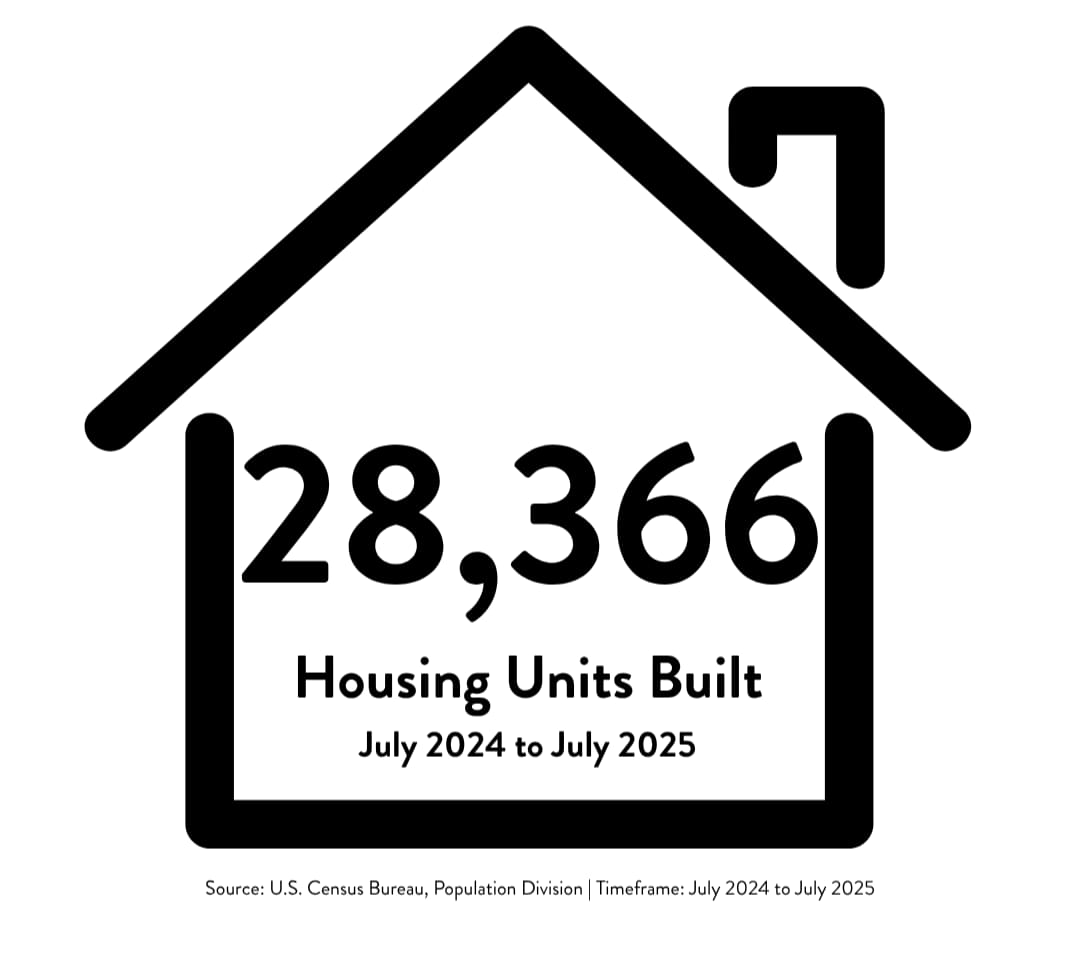
Housing supply across the Charlotte Region has kept pace with the demand that migration brings. Between 2024 and 2025, the region added more than 28,000 housing units, pointing to sustained residential development.
“Charlotte’s continued growth reflects the confidence people have in this region as a place to relocate, build careers, raise families, and invest in their future,” said Anne Marie DeCatsye, Esq., CEO of Canopy Realtor® Association and Canopy MLS. “That confidence is reflected in the housing market as well. For the past decade, buyer demand has remained consistent, fueled by steady in-migration, job creation, and strong population growth. At the same time, home prices have remained below the national median, making the Charlotte region an attractive option compared to many peer markets.”
Between 2024 and 2025, Mecklenburg County added 11,320 housing units, followed by York County (2,483), Cabarrus County (2,279), Union County (2,251), Gaston County (1,964), Catawba County (1,945), and Iredell County (1,930).
To meet that growth, Charlotte City Council is proposing a $425 million bond referendum to be added to the November ballot, creating funding for housing, transportation, and neighborhood improvements. The $125 million earmarked for affordable housing builds on the $100 million housing bond voters approved in 2024. Across the region, Mecklenburg County’s nearly $20 billion infrastructure investment approved last year, the Riverbend Preserve housing development on the Lincoln-Gaston County line, and a $36 million highway-widening in York County point to a region investing at every level.
Conclusion
The Charlotte Region continues welcoming new residents at a consistent pace, showing this region remains a priority destination for families, talent, and businesses, both domestic and international. Even with international migration slowing down nationally, the Charlotte Region’s resilience stands out among much larger MSAs.
This level of sustained growth is both a sign of strength and a responsibility. As the Charlotte Region continues to welcome 135 new residents every day, meeting that demand with smart investments in housing, infrastructure, and workforce development will be critical to ensuring growth translates into lasting opportunity. The Charlotte Regional Business Alliance is rising to the challenge with a mission of growing existing businesses, attracting new ones, and improving quality of life for everyone who calls this region home.
1 As of 2026, the Charlotte Region is known as the following counties: Alexander, Burke, Cabarrus, Chester, Chesterfield, Catawba, Cleveland, Gaston, Iredell, Lancaster, Lincoln, Mecklenburg, Rowan, Stanly, Union, and York.
View this post on Instagram